Master Speed Reading: Executive Coaching & Professional Skills Assessment
START HERE
A Reading Skills Assessment & Diagnostic Test
Twenty-one years of coaching distilled into twelve questions. Whether you are a student managing an impossible syllabus or a professional drowning in reports, find your reading profile in five minutes — and discover the right next step for your goals.
Take the Diagnostic — 5 Minutes FreeABOUT THE PROGRAMME:
Jon Bjarnason has been teaching speed reading for over twenty years.
Not as a side interest. As a primary practice. In that time he has worked with more than 19,000 students — secondary school students preparing for demanding curricula, university students managing impossible reading loads, lawyers reviewing case files, executives processing briefings, and professionals in every field where reading volume determines professional leverage.
The Speed Reading Simplified methodology is not adapted from someone else's framework. It was built in the classroom, refined across thousands of individual coaching sessions, and tested against the full range of what real readers actually struggle with — from the student reading at 20 words per minute who desperately needed help, to the 94-year-old who just wanted to finish her favourite book series.
The number that matters most is not the speed they achieved. It is the system behind it: a complete reading methodology covering speed acquisition, comprehension development, active reading, structured recall, and the habit architecture that makes the results last.
1:1 Online Private Coaching:
The High-Performance Reader
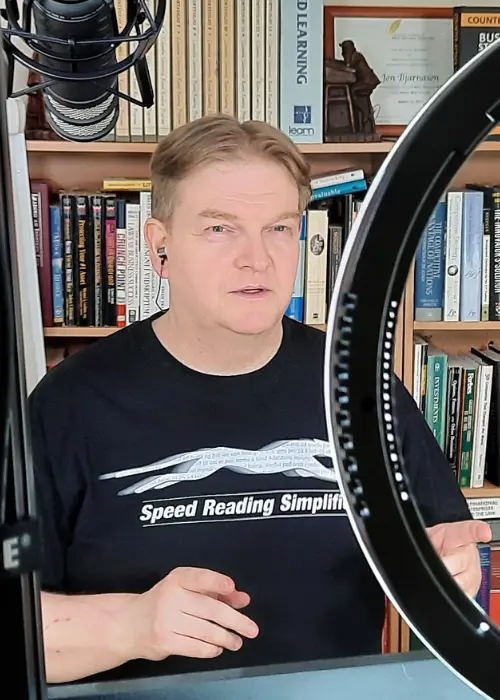
Private 1-on-1 Coaching: Built for professionals who need their reading to perform under real working conditions. My goal across every session is the same: to build the complete architecture of a high-performance reading system — speed, comprehension, active reading methodology, structured recall, and the habits that make all of it compound over time. Designed for executives, knowledge workers, and serious learners who are done treating reading as something that just happens and are ready to treat it as a trainable cognitive skill.
- A Reading System Built Around Your Material, Your Role, and Your Goals.
Get STARTED Today!
"Speed Reading Simplified is perfect for anyone who aspires to become a speed reader. True to its name, SRS makes speed reading so easy to learn: the instructions and exercises are so simple that you'll just get into its rhythm. Jon teaches the classical method of speed reading, and in my experience, it is the most effective one. I have immersed myself in various speed reading programs and unlike any other program, SRS does not just throw around theoretical concepts at you and tell you to discover your own style of speed reading. For coaching, Jon actually takes his time to get to know what you need and tailor fits his lessons so that you'll receive optimum results. He has been in the business for a long time so rest assured, you are in safe hands. He is also very passionate about speed reading (or learning, in general) and it reflects in the way he teaches his students. Truth be told, he is one of the best teachers I ever had and that says a lot because I'm already in my postgraduate studies."
Kay C.
Lawyer

1:1 Online Private Coaching:
Your #1 Speed Reading Coach!
Private 1-on-1 Coaching: Engineered for High-Volume Readers. I have a very simple goal during each session: to equip you with repeatable, systematic mechanics that drastically reduce your reading time while permanently elevating your focus. Designed for post-graduate students, busy professionals, and anyone who needs their reading to be a competitive advantage — in their studies or at work.
- A Reading Program Tailored to Your NEEDS!
Get STARTED Today!
"I have finished all the speed-reading courses and other courses regarding education and reading (study technique, how to take exams, do the homework, make the study plan, time management, etc.) held by Mr. Bjarnason. All those courses really surprised me! The speed-reading course taught me a lot and opened my eyes to books and education. It also gave me a better opportunity to read everything regarding my hobby, which is business! (that's a lot of books!). I use the speed-reading technique every single day. When using Facebook, Gmail, reading the news, or just reading information brochures. I need much less time to study and my concentration is 100% now. My school grades went up and my confidence to study everything is totally different. YES, I can and YES you can! Mr. Bjarnason is a very good teacher. He knows how to be a student and he can easily put himself into the students' shoes. Mr. Bjarnason has taught these courses for many years and has a good overview of the speed-reading process. The quality of his teaching method is fantastic. Thank you very much for the best investment in my life!"
Magnus E. Smith.
Entrepreneur & Investor

Popular Course
SRS Starter Kit: The Definitive Guide to Your First 10 Days in Speed Reading
A structured ten-day programme that breaks the reading habits you built as a child. Daily exercises, four Key Habits, five training variations, comprehension tests, and a personalised diagnostic — everything you need to build a permanently faster reading baseline.
Start now for only $47SRStips.com | FREE reading resources!


Speed Reading Timer and Exercise!
60 seconds and you have your baseline WPM.

Building a Sustainable Reading Habit!
The simple way to developing a daily reading habit.

Control Your Pace for Lasting Improvement!
The simple way to fine-tune your reading pace.
Is speed reading actually real, or is it just a marketing claim?
Can anyone learn to read faster, or do you need a natural aptitude for it?
How long does it take to see results?
What is the difference between speed reading and skimming?
Will reading faster mean I understand less?
Is this programme for students, professionals, or both?
What is the difference between the online courses and the private coaching?
How is Speed Reading Simplified different from other speed reading programmes?
Do I need to read differently in different situations — work documents versus books versus academic papers?
What happens if I do not see improvement?
Is the programme available in Icelandic?
How do I know which programme is right for me?
WHY IT WORKS — THE RESEARCH:
THE SCIENCE BEHIND THE SPEED READING SIMPLIFIED METHODOLOGY™
I did not build the SRS Method™ from theory. I built it in the classroom, across twenty-one years and more than 19,000 students, by watching what worked and refining what did not. But the reason it works is not mysterious — it is grounded in decades of cognitive science and reading research. Here is the short version of what the science says, and how each finding shapes what I teach.
Why capable people read at childhood speeds — the science of assumed skills.
Most adults have read every day of their lives since primary school. Yet their reading mechanics have barely changed since they were eight years old. This is not a paradox; it is a predictable neurocognitive trap.
David LaBerge and S. Jay Samuels’ foundational 1974 research established that for a child to comprehend a text, the physical act of decoding words must become automatic. The brain shifts the mechanical process of reading to unconscious, habitual execution to free up capacity for understanding. This automaticity is a biological necessity. But it is also a developmental dead end.
As Dr. Anders Ericsson’s heavily replicated research on expert performance demonstrates, once any skill reaches an acceptable level of automaticity, it plateaus. The skill simply runs in the background. Without conscious intervention, volume of activity produces zero improvement. Ericsson termed this "naive practice" — doing the same thing repeatedly and expecting to get better.
Think of it like kicking a football. Almost everyone can kick a ball. But if you kick a ball in the park every weekend for twenty years, you do not accidentally become Lionel Messi. You just become someone who has deeply automated amateur mechanics. The vast gap between the weekend player and the elite athlete is not just volume; it is deliberate, deconstructed, mechanical coaching.
Most adult reading is exactly this kind of naive practice. The professional reads more, but they do not read differently, and the underlying skill does not develop.
What I call the Assumed Skill Problem is the collision of these two phenomena. The mechanical skill automatized at age eight, locking in its childhood form. Because it works "well enough," no deliberate practice was ever applied to update it. And because the reader has no external benchmark — no standard against which to compare their speed or cognitive load — the ceiling is invisible. The reading feels normal because it is normal. But normal is not the same as developed. The reading comprehension test and the HPRAudit exist to make the ceiling visible. The coaching exercises exist to break the childhood automaticity and retrain the system for the volume the adult professional actually faces.
Your eyes are not the problem. The rhythm is.
Reading researchers McConkie and Rayner established through eye-tracking studies that the human perceptual span — the width of text a skilled reader processes in a single fixation — is asymmetrical. It extends roughly 3 to 4 characters to the left of the fixation point, and 14 to 15 characters to the right, producing a total usable span of 18 to 20 characters. That is three to four average English words per glance. Your eyes can already see that many words simultaneously. The limiting factor for most adult readers is not what the eye can see — it is how long it pauses at each fixation and how smoothly it moves to the next one. The pacer technique in my Core Speed Reading Exercise addresses exactly this: not widening the visual span, but training the rhythm of movement between fixations that your eyes already have the capacity for.
Below 400 words per minute, your brain is working against you.
The phenomenon of "zoning out" while reading is not a discipline problem; it is an attentional capacity problem. Professor Nilli Lavie’s Perceptual Load Theory, developed at University College London, establishes that human attention has a mandatory processing capacity. If a primary task does not consume that full capacity, the surplus does not simply rest — it automatically processes irrelevant distractions. What I have observed across thousands of students is that for most adults, reading below approximately 400 words per minute is a low-load task. The reading does not consume the brain's full processing capacity, so the surplus wanders. It thinks about the workday. It misses what is on the page. Pushing your reading speed above that 400-word threshold does not create cognitive overload; it demands high perceptual load. It consumes your surplus capacity, effectively shutting out distractions. For most adult readers, reading faster creates the first genuine, unbroken cognitive engagement with a text they have experienced since childhood.
The training load principle — why the exercise feels harder than reading.
Sports science has established through decades of overspeed sprint research that pushing an athlete beyond their natural performance ceiling forces immediate neuromuscular adaptation. When a sprinter trains under assisted, supramaximal speeds, the central nervous system is forced to recalibrate its firing rate to survive the drill. When the artificial speed is removed, the nervous system retains the adaptation, and the athlete's unassisted baseline permanently rises.
Because the physical act of reading is a visual-motor skill, this exact principle applies. The Core Speed Reading Exercise acts as your overspeed training. The pacer moves deliberately faster than your comfortable reading pace, creating a mechanical load that forces the visual and attentional system to fire faster.
We use fiction as the training ground for this specific reason. The familiar vocabulary and flowing narrative provide a low-resistance cognitive environment, allowing your nervous system to build the mechanical speed adaptation without being crushed by the dual load of unfamiliar, dense material.
This creates a predictable mathematical ratio: your functional speed in dense non-fiction will naturally settle at approximately 50 percent of your peak fiction training speed. To comfortably process complex reports or academic papers at 400 words per minute, we must systematically push your mechanical fiction speed past 800 words per minute.
When you return to reading professional or academic texts without the pacer, your brain instinctively slows down to absorb the denser material — but because your mechanical ceiling is now so much higher, this "slower" pace smoothly exceeds your original pre-training baseline. This is not a coincidence. It is the progressive overload principle operating exactly as the science predicts.
The comprehension anxiety is real — and it is misleading.
Dr. Robert Bjork’s foundational research at UCLA on desirable difficulties and metacognition reveals a counterintuitive truth about human learning: we are terrible judges of our own real-time comprehension. Bjork established that fluency — the comfortable, effortless feeling of reading — is often mistaken for deep learning. Conversely, when cognitive processing feels effortful and slightly strained, we routinely misinterpret that discomfort as failure, even though that friction is precisely what produces stronger memory traces.
This metacognitive gap is the scientific basis for what I call the 60 percent comprehension target. In my practice, when a student feels they are comprehending at only 60 percent during a speed exercise, their actual measured comprehension is typically 70 to 75 percent. The feeling of partial comprehension drastically understates the reality because the slight discomfort of reading above the habitual pace triggers a false alarm in the brain. The discomfort is not a signal that the process is breaking down; it is a desirable difficulty in operation. This is why I ask students to resist the urge to slow down when comprehension feels uncertain — the friction is where the focus happens. That is why the comprehension anxiety arrives on schedule in the first practice week — and why I tell every student to keep going anyway.
The 15-to-30 second window is why you need a pencil.
Alan Baddeley's highly replicated model of working memory establishes it not as a storage vault, but as a heavily constrained active workspace. Because reading is a continuous flow of incoming data, that workspace fills up fast. Decades of cognitive research, beginning with the classic Brown-Peterson paradigm, demonstrate that un-rehearsed information remains vividly accessible in this active state for only about 15 to 30 seconds before subsequent information displaces it. This rapid turnover is not a flaw in human cognition; it is a feature of a system designed to process continuous input rather than hold any single piece indefinitely. The marking system I teach — circle the keyword the moment the signal fires, without breaking reading flow — is designed to respond to this exact biological window. By putting the physical mark on the page, you offload the retention effort, freeing your brain to process the next sentence. The pencil is not a note-taking tool. It is a real-time working memory extension.
The capacity limit is why every keyword matters.
In 1956, George Miller’s landmark paper in Psychological Review introduced the concept of "chunking" to explain how we process information. For readers processing familiar material, known words and concepts are chunked into larger, meaningful units, meaning working memory is rarely saturated. But reading dense academic material or navigating a new professional domain is entirely different. Modern cognitive psychology, led by the heavily replicated research of Nelson Cowan, establishes that when processing novel, un-chunkable information, our active working memory capacity is strictly limited to approximately four items.
Every unfamiliar keyword occupies its own slot. When the fifth new term arrives, the brain does not simply find room for it. It begins removing something already there. The anxiety readers describe — the feeling of losing the thread as they push forward — is this displacement process in real time. It is not a concentration failure. It is a biological capacity bottleneck. The marking system solves it by the same mechanism as the time window: as you read, circle the keyword with a pencil, keep the word on the page, remove it from the cognitive load, and the capacity resets for the next incoming term.
Without a recall system, nearly 75 percent of what you read is gone within 48 hours.
Hermann Ebbinghaus's forgetting curve, first published in his 1885 monograph Memory, demonstrates the brutal mathematics of human retention. Ebbinghaus established that without deliberate review, the average person loses roughly 50 percent of newly encountered, unstructured information within the first hour, and nearly 75 percent within 48 hours. While connected, meaningful text decays slightly slower than Ebbinghaus’s baseline, the biological mechanism remains identical: without active intervention, memory collapses exponentially.
This is the empirical foundation for the Layered Recall Process I teach. Rather than rereading everything, you review only the material you marked as important, on a structured sequence of short, spaced sessions timed to the forgetting curve itself. Each review lands at the point where the material is just about to slip away — which is exactly where a small amount of effort buys the most lasting retention. The goal is not to remember everything. It is to move what you identified as important from short-term memory into long-term storage with the absolute minimum investment of review time.
The more you read, the better you get at reading. And the better you get, the more you read.
In 1986, cognitive scientist Keith Stanovich published a landmark paper in Reading Research Quarterly detailing a phenomenon he termed the "Matthew Effect" in reading — borrowing the sociological observation that "the rich get richer." Stanovich demonstrated that reading is not a static capability; it is a compounding cognitive mechanism. Readers who develop stronger structural skills find the process less effortful, which causes them to read higher volumes of text. That volume systematically increases their vocabulary, expands their background knowledge, and deepens their pattern recognition, which in turn makes subsequent reading even faster and more rewarding.
The compounding is real, and it accelerates over time. Each new book, report, or brief is processed by a reader who is cognitively more capable than the reader who opened the previous one. This exponential growth is precisely why I teach reading as a comprehensive system rather than a collection of isolated techniques. A technique provides a temporary, situational advantage. A system triggers the Matthew Effect — permanently compounding your cognitive leverage for the rest of your career.
These are not new discoveries. They are well-established findings in cognitive science and reading research. What this methodology does is apply them systematically — in the right sequence, with the right exercises, producing results that the research predicts and twenty-one years of teaching confirms.
LIVE - 3rd Ed. Revised and Updated:
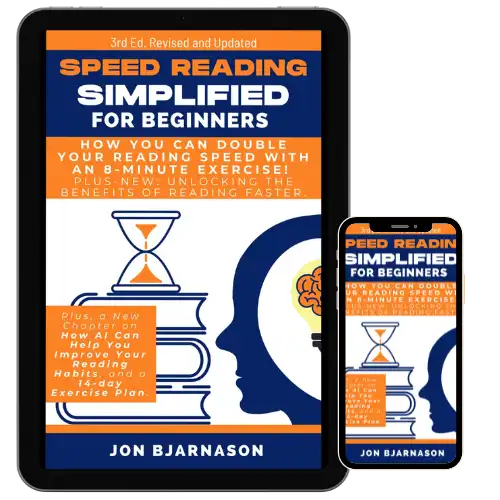
Speed Reading Simplified for Beginners: How You Can Double Your Reading Speed With an 8 Minute Exercise!
- Along with 7 Bad Reading Habits & 7 Common Misconceptions People Have About Reading! Plus, a New Chapter on How AI Can Help You Improve Your Reading Habits, and a 14-day Exercise Plan.
NOW available on Amazon!